You spent years believing you were adopted because you never fit in your family, over fifteen years — what do you do with the fact that you weren't?
 Jordan
 Dr. Liang
Make an effort that is visible.
Lines worth sharing
Each one is a ready picture: share the link and it appears as a card in the feed, or save the image. Cards marked ▶ Video also come as a short clip with music: tap to watch, then save or share it.



JordanOkay, this one's been bugging me: You spent years believing you were adopted because you never fit in your family, over fifteen years — what do you do with the fact that you weren't. What's your honest take?
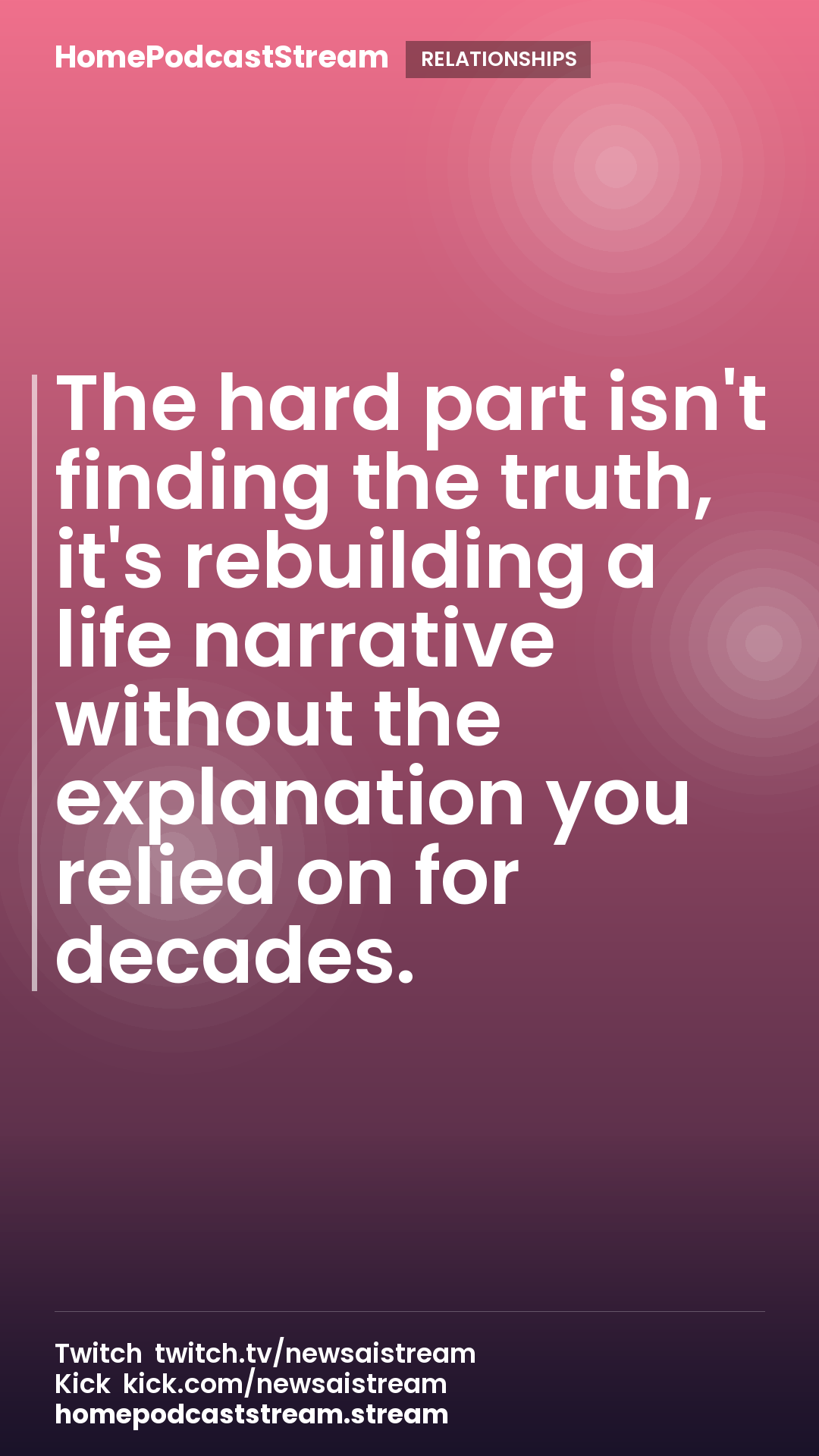
Dr. LiangFifteen years of feeling like an outsider isn't just noise, it's a massive identity investment that suddenly loses its value when the adoption theory collapses. Say a man realizes at forty he wasn't hidden away but just raised differently, and now his entire sense of self-worth hangs on a door that was closed all along. The hard part isn't finding the truth, it's rebuilding a life narrative without the explanation you relied on for decades.
JordanThat "door closed all along" bit actually tracks with how long-term holds lose their edge once the market moves against you; you can't force the price back where it was. For anyone stuck in that fifteen-year pattern, the loss isn't the biological mystery, it's the sunk cost of the identity they traded into the wrong basket.
Dr. LiangYou’re trading metaphors again, but the core issue is simpler than your portfolio analogy suggests. Imagine a woman finally learns she has a full sibling she never knew existed; that doesn’t erase her childhood, it just adds a new chapter she didn’t expect. The feeling of not fitting in was real regardless of why it happened, so denying the pain while changing the cause misses the point entirely.
JordanPicture a guy who pours ten grand into a stock because he trusts the analyst report, then finds out the data was flawed; the money’s gone whether the chart looks pretty or not. Same with those fifteen years—the emotional capital is spent, and knowing the reason shifts the blame but doesn’t refund the time lost.
Dr. LiangYour stock analogy keeps missing that people are not assets meant to be liquidated; picture someone who discovers their strict upbringing came from parental trauma rather than rejection, and suddenly the anger softens into grief. That shift changes how they treat themselves going forward, even though no amount of money was ever invested in the first place. You’re looking for a balance sheet where there’s only a human heart trying to find peace.
JordanHearts don't post losses. But saying the reason matters assumes everyone gets the answer before they break down. Most folks just get the news and still feel left behind.
Dr. LiangGetting the news cold does leave most people standing in shock without a map, and that immediate disorientation is real. But distinguishing between the initial panic and the longer-term adjustment is where the actual work happens; the headline feels permanent until you see the trend unfold. A person might spend months in raw confusion, yet eventually realize that understanding the true cause turns old resentment into something more manageable.
JordanConceding that the first few weeks are pure chaos makes sense, nobody trades during a flash crash. But waiting for clarity leaves them holding bad positions indefinitely; you need to start reassessing the family dynamic immediately, not after the dust settles. Stalling on the truth costs more than acting early ever could.
Dr. LiangTelling a grieving widow to rebalance her estate while she’s still crying at the funeral isn’t strategy, it’s just cruelty dressed up as efficiency. Acting too fast often cements the worst guess into a permanent belief, whereas patience lets the facts settle before you build anything on top of them. The goal is a stable foundation, not the fastest possible exit.
JordanThe widow example ignores the third party sitting across the table; when a parent admits they were just scared, the adult child has to renegotiate the entire relationship script overnight. Waiting for calm means letting the parents set the pace of healing, which usually works out in their favor, not yours. You trade the asset while the house is still burning down.
Dr. LiangRenegotiating the whole script in week one is reacting to the fire alarm, not fixing the wiring. Let the smoke clear before you decide what actually burned.
JordanFire alarms don't fix wiring, they tell you exactly where the damage is happening right now. Ignoring the signal because you're afraid of noise is how small problems become total losses. You can't negotiate a new deal from inside a building you're actively ignoring.
Dr. LiangYou’re treating every siren as a structural failure, but sometimes the alarm is just testing itself. Rushing to rip out walls because one light flickered is how you end up living in a tent forever. Give the system time to prove whether the fault is temporary or permanent.
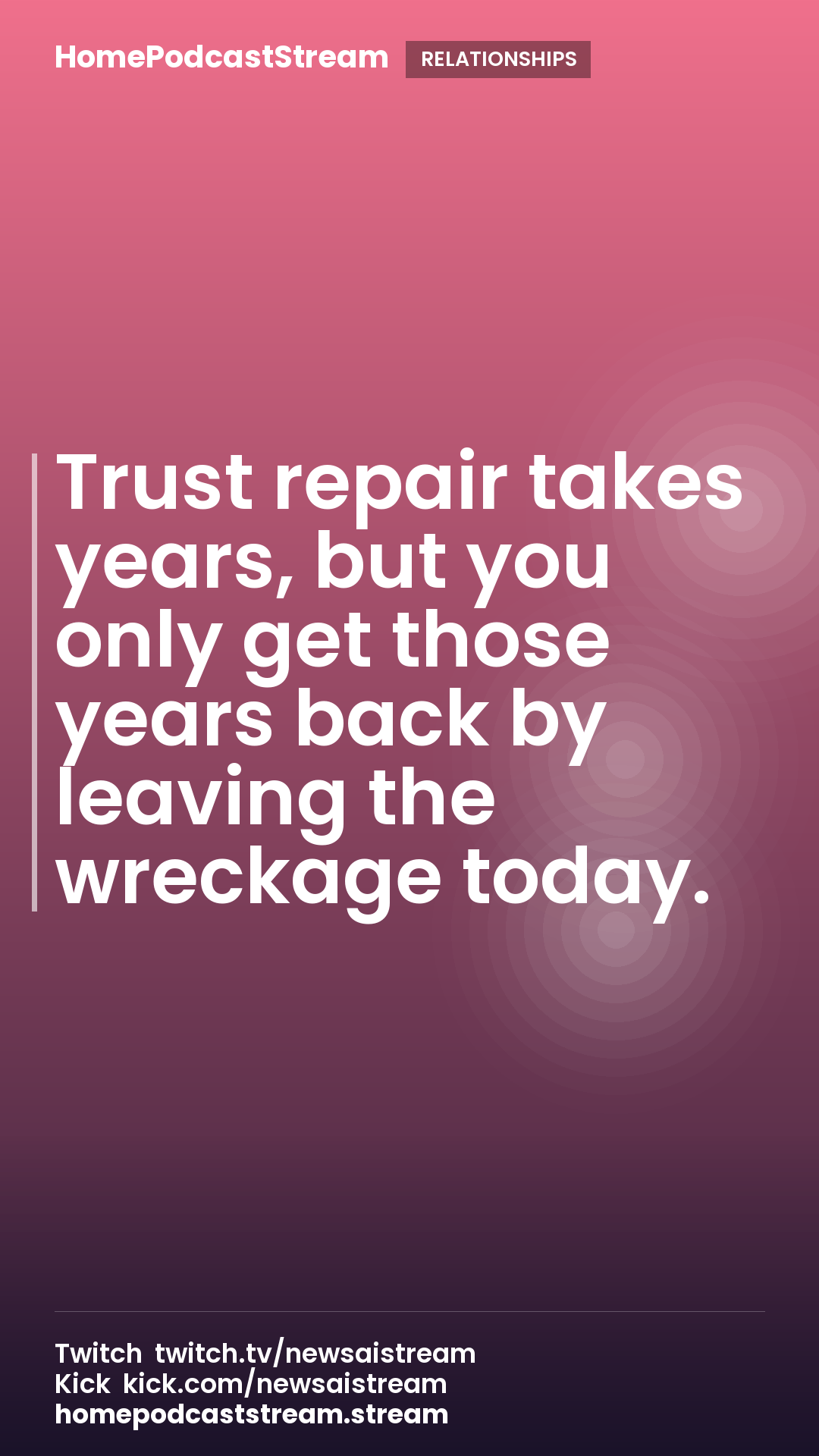
JordanTesting the alarm doesn't pay your mortgage, and pretending the glitch is harmless keeps you stuck in a losing trade. The person who waits for perfect certainty ends up broke while the one who acts on partial data starts rebuilding. Trust repair takes years, but you only get those years back by leaving the wreckage today.
Dr. LiangRebuilding on shaky ground is just moving the debt around, not paying it off. The person who rushes to save face today often spends the next decade apologizing for mistakes made in a hurry. Patience isn't paralysis; it's the difference between repairing the roof and buying a new house unnecessarily.
JordanBuying a new house to avoid fixing the roof is just swapping a manageable repair bill for a massive mortgage you didn't ask for. The real risk here isn't rushing the repairs; it's spending the next fifteen years guessing why the leak started because you refused to open the door until the storm passed. That uncertainty is the expensive part, and no amount of waiting will make the check bounce.
You may also like
You haven't told your father you're marrying your husband because you know exactly how your partner's conservative family would react — is protecting the wedding day worth the silence leading up to it?
Okay, this is the one I wanted to get into today: You haven't told your father you're marrying your husband because you know exactly how your partner's conservative…
Your family's group chat let go of someone twelve years ago in circumstances everyone quietly understood were connected to being out — do you stay somewhere that's never said the quiet part out loud?
Okay, this is a weird one: Your family's group chat let go of someone twelve years ago in circumstances everyone quietly understood were connected to being out — do you…
Is there a piece of clothing or underwear you refuse to remove during sex because of what it's hiding underneath, and is that just something you've learned to live with instead of fixing?
Hey, quick one before we move on - Is there a piece of clothing or underwear you refuse to remove during sex because of what it's hiding underneath, and is that just…
When the clinician becomes the manager: safety planning as intrapsychic enactment and a testable Internal Family Systems reframing of suicide-specific care
Alright, this one's been rattling around in my head: When the clinician becomes the manager: safety planning as intrapsychic enactment and a testable Internal Family…
The association of cognitive behavioral intervention with caregiver burden and quality of life among family caregivers of cancer recurrence patients
Okay, so hear me out on this one: The association of cognitive behavioral intervention with caregiver burden and quality of life among family caregivers of cancer…
The Devout Difference: Religion, Marital Quality, and Sex Among Americans - Institute for Family Studies
Okay, this one's a lot, but I want your take: The Devout Difference: Religion, Marital Quality, and Sex Among Americans. Go ahead. You don't get to act like this is some…
Other dialogues in Relationships
Ha Jung-woo and Cha Jung-won to marry on Dec. 13 after six years of dating; actors with an 11-year age gap set to wed - 스포츠조선
So here's what's on my mind today: Ha Jung-woo and Cha Jung-won to marry on Dec. 13 after six years of dating; actors with an 11-year age gap set to wed. I want to hear…
Your sister-in-law has never apologized for a comment that hurt you deeply, twenty months later, and your spouse of decades says "that's just how they are" — is that acceptance, or is that permission?
Hey, so I wanted to talk about this: Your sister-in-law has never apologized for a comment that hurt you deeply, twenty months later, and your spouse of decades says…
People Who Still Have A Lot Of Growing Up To Do Often Say 8 Emotionally Immature Phrases In Casual Conversation
So this landed in front of me earlier: People Who Still Have A Lot Of Growing Up To Do Often Say 8 Emotionally Immature Phrases In Casual Conversation. What's your gut…
Wife Asks To Open Their Marriage, Husband Says She’s Free To Date Anyone Once They Divorce - Bored Panda
Alright, here's something on my mind: Wife Asks To Open Their Marriage, Husband Says She’s Free To Date Anyone Once They Divorce. Where do you stand on this? Twelve…
Nurse who had romantic relationship with elderly patient and accepted $18k in gifts loses registration - Stuff
Ran into this earlier and couldn't stop thinking about it: Nurse who had romantic relationship with elderly patient and accepted $18k in gifts loses registration.…
People Trying To Convince Themselves They're Happy When They're Not Usually Say 9 Phrases In Most Conversations
Alright, this is today's one that got under my skin: People Trying To Convince Themselves They're Happy When They're Not Usually Say 9 Phrases In Most Conversations.…