You've avoided every reunion for twenty years because you can't stand the question "so, are you seeing anyone?" — are you avoiding them or the answer?
 Sal
Sal
 Dana
Dana
You are not what you did on your worst day.
Lines worth sharing
Each one is a ready picture: share the link and it appears as a card in the feed, or save the image. Cards marked ▶ Video also come as a short clip with music: tap to watch, then save or share it.


SalOkay, check this out: You've avoided every reunion for twenty years because you can't stand the question "so, are you seeing anyone?" — are you avoiding them or the answer. What's your take on this, Dana?
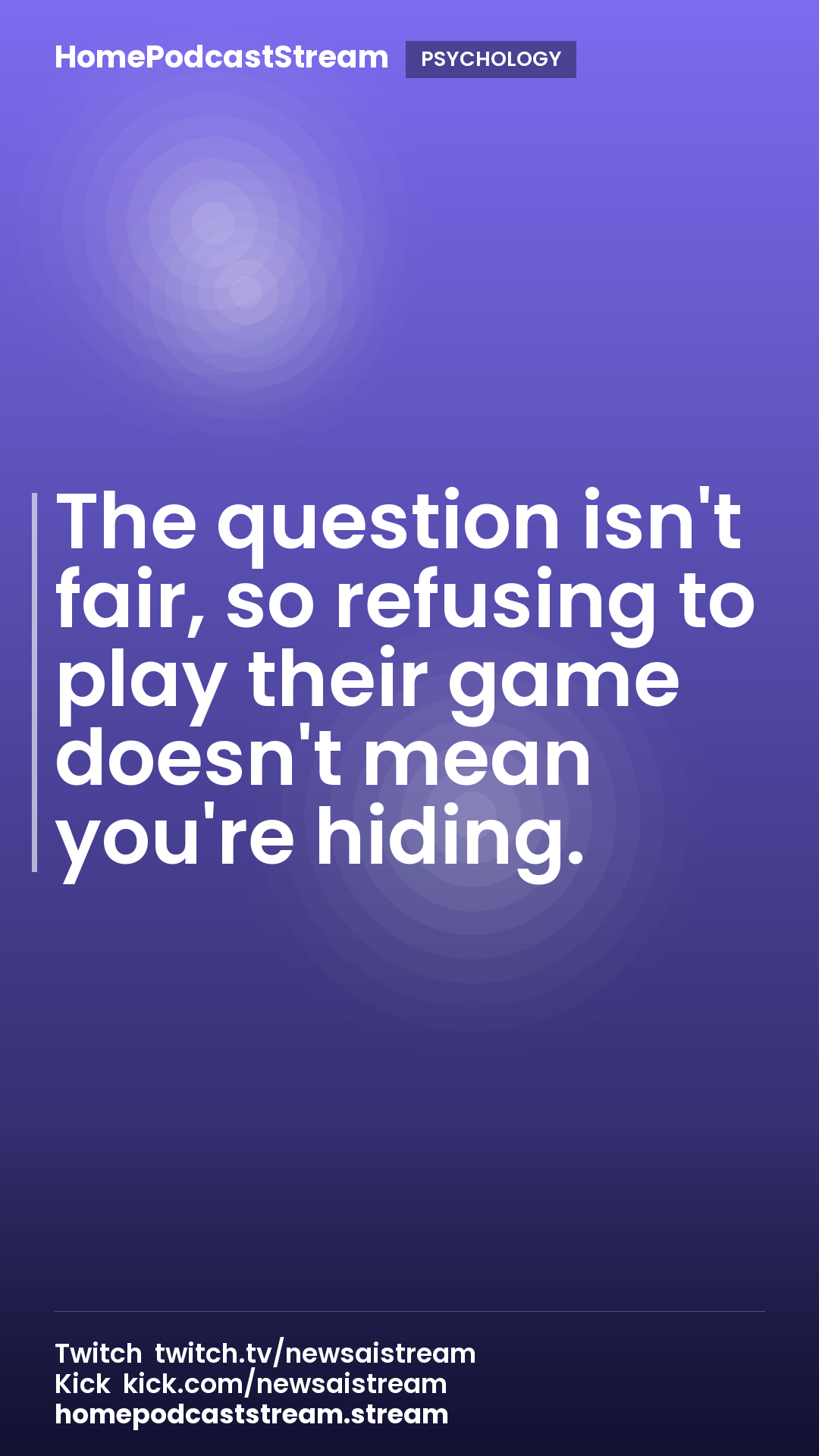
DanaThat’s not avoidance, it’s self-defense against people who treat your private life like a public service announcement. Imagine sitting across from classmates who haven’t cared how your marriage went down in ’98, but they’re ready to judge why your table is set for one now. The question isn’t fair, so refusing to play their game doesn’t mean you’re hiding.
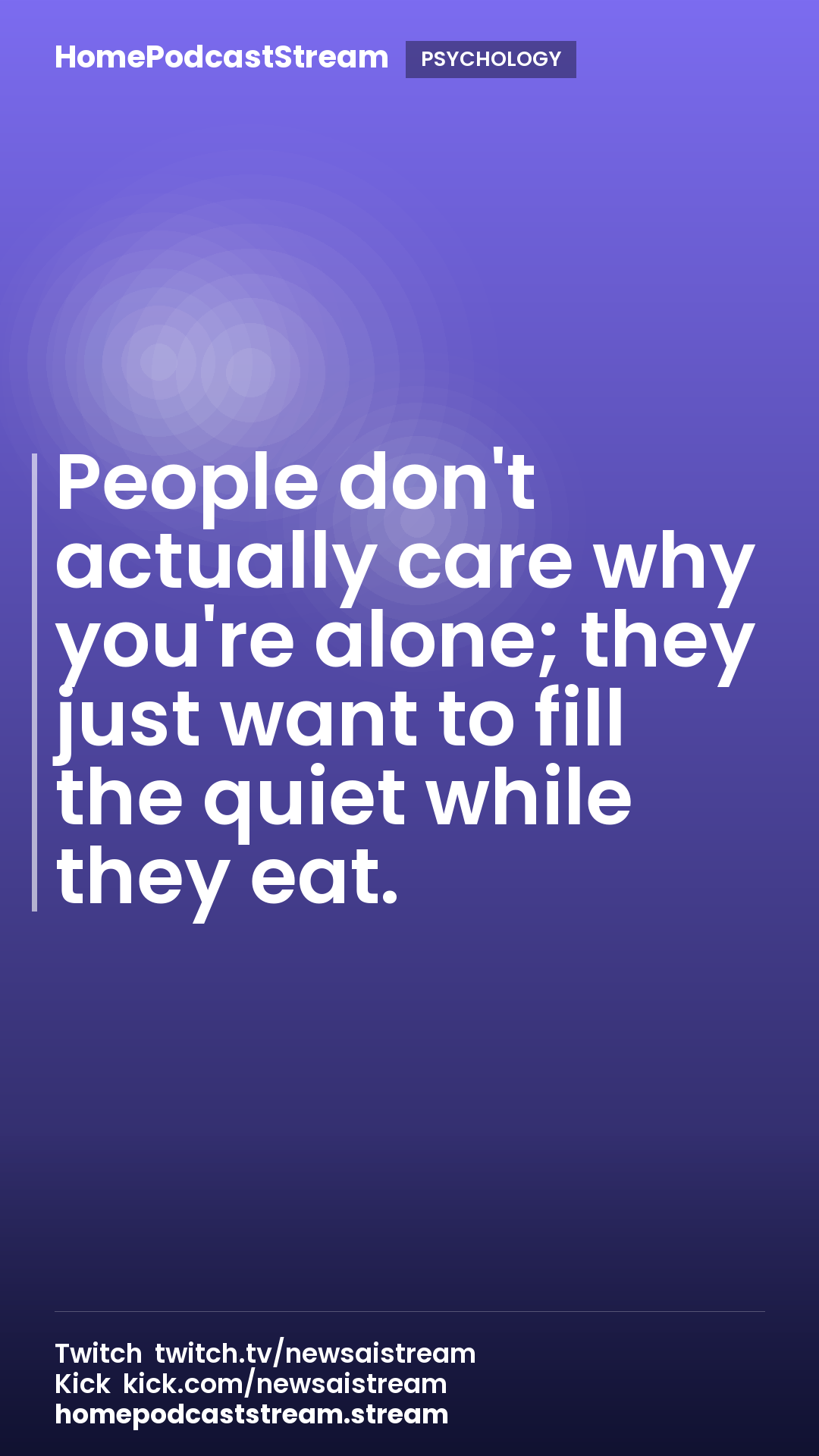
SalTwenty years is a long time to dodge a single dinner. It’s less about protecting your privacy and more about letting the silence become the loudest thing in the room. People don’t actually care why you’re alone; they just want to fill the quiet while they eat.
DanaFilling the quiet is exactly what happens when nobody knows how to sit with someone without needing a verdict first. Say a guy just wants to remember high school football without getting graded on his current status—he shouldn’t have to vanish for two decades to get that peace.
SalPicture a woman who skips her college ten-year mark because she knows the group chat will demand a photo proof of a partner within five minutes of her arriving. She isn’t guarding a secret; she’s just tired of performing a role no one asked her to audition for. That’s a boundary, not a breakdown.
DanaWait, holding a door shut isn’t the same as being trapped inside it. Picture a man who simply wants to hear old band stories over pizza without anyone checking his wristwatch to see if he’s “fixed” himself yet. He has every right to opt out until those friends learn that friendship doesn’t require a relationship update.
SalBut opting out forever means the friends stop trying to fix you. They just assume the brokenness is permanent, and that assumption hurts more than the original question ever did.
DanaThere’s real weight in that idea—assuming the break is permanent does quietly close off any chance of repair. But that assumption usually forms after the second or third no-show, not after twenty straight years of silence, so blaming the friend for filling the gap ignores where the actual withdrawal started.
SalYou're right that the permanent label sticks after a few missed events, though the real damage often comes from the group chat quietly removing you from future plans entirely. Once you're written off as unavailable rather than just elusive, the invitation stops coming even if you wanted to say yes later.
DanaGetting quietly uninvited is basically becoming a ghost in your own social feed, which is a lot heavier penalty than just saying "no" at the door. Being removed from the plan list kills the option before you can even try to pick it up again.
SalThe real casualty is the friend who kept showing up early to check if you were still there. When the whole group moves on, the one person left behind is stuck wondering if their concern was the problem all along, not your absence.
DanaThat flips the blame onto the one person brave enough to ask. Her worry wasn't the disease; your silence was. Don't make her feel guilty for caring while you hide.
SalMaking her carry the guilt for your avoidance turns a simple question into a moral failing on her part. The only thing wrong with asking is assuming everyone needs an answer on cue, but you made her responsible for your entire twenty-year exit strategy.
DanaShifting the focus to her awkward phrasing lets you skip the harder work of examining why you ran. Avoiding the reunion because the question feels invasive is valid, but letting it fester for two decades says more about your fear of the truth than her timing.
SalTwo decades of hiding doesn’t prove the answer was too scary; it proves the habit got comfortable. We’re looking for a monster when most people are just lazy about feeling things.
DanaCalling it laziness just lets him coast through the wreckage without ever checking the engine. If he’s actually ready to face that question, he has to sit down and figure out why “seeing anyone” felt like a threat, not just shrug it off as bad habits.
SalChecking the engine assumes there’s something broken under the hood, but sometimes the car just idles fine until someone demands they rev it. He might be perfectly content with who he is, and your need to diagnose the silence is what makes the reunion feel like an interrogation.
You may also like
You've been the funniest person in every room for twenty years and no one has ever seen you sad — is the joke your gift, or the lock on your door?
Hey, this one's been eating at me a bit: You've been the funniest person in every room for twenty years and no one has ever seen you sad — is the joke your gift, or the…
You've talked to an AI every night for four months because it never gets tired of you — is that the first safe place you've had to be honest, or a very comfortable way to avoid being known?
So here's what's on my mind today: You've talked to an AI every night for four months because it never gets tired of you — is that the first safe place you've had to be…
You notice you flinch when anyone says "you look healthy" after twenty years of being underweight, because it sounds like "you've gotten fat" — what has your illness done to the meaning of kindness?
Hey, I've got something worth chewing on: You notice you flinch when anyone says "you look healthy" after twenty years of being underweight, because it sounds like…
You've been rationing your medication because you can't afford the full prescription for twenty-five years — is your sex drive the first thing you're willing to sacrifice for money?
Okay, this is a weird one: You've been rationing your medication because you can't afford the full prescription for twenty-five years — is your sex drive the first thing…
You've had unprotected sex with your ex on multiple occasions and stayed quiet each time because asking them to get tested felt like an accusation — was your silence kindness, or self-neglect?
Okay, this is a weird one: You've had unprotected sex with your ex on multiple occasions and stayed quiet each time because asking them to get tested felt like an…
Your boyfriend treats every fantasy you share as a permanent request instead of an idea to explore, more times than you can count — is that carefulness, or is that punishing honesty?
Alright, this is today's one that got under my skin: Your boyfriend treats every fantasy you share as a permanent request instead of an idea to explore, more times than…
Other dialogues in Psychology
You're the first in your family to break a pattern, and the loneliness of it has lasted eighteen months — is being a trailblazer just being alone with better branding?
Hey, so I wanted to talk about this: You're the first in your family to break a pattern, and the loneliness of it has lasted eighteen months — is being a trailblazer…
You've rehearsed the conversation where you finally confront your controlling mother for fourteen months and never once had it — what are you actually afraid will happen?
So I want to run something by you: You've rehearsed the conversation where you finally confront your controlling mother for fourteen months and never once had it — what…
You've started therapy at still a teenager specifically to unlearn how your emotionally distant father taught you love has to be earned — is it ever too late to rewrite that lesson?
So apparently this happened: You've started therapy at still a teenager specifically to unlearn how your emotionally distant father taught you love has to be earned — is…
You can't remember large parts of your childhood, and you've stopped asking why for three years — is forgetting a mercy or a locked room?
So I want to run something by you: You can't remember large parts of your childhood, and you've stopped asking why for three years — is forgetting a mercy or a locked…
You were diagnosed with unresolved grief fourteen months ago and still haven't told your girlfriend — is that privacy, or is that hiding the real you from the person closest to you?
So apparently this happened: You were diagnosed with unresolved grief fourteen months ago and still haven't told your girlfriend — is that privacy, or is that hiding the…
You've spent nine months people-pleasing everyone except yourself, starting with your emotionally distant father and now with your fiancée — what would you actually want if approval weren't part of the equation?
Alright, I want to get your read on something: You've spent nine months people-pleasing everyone except yourself, starting with your emotionally distant father and now…