Your devoutly religious mother finally used the right pronouns for you after five months of correcting them, and acted like it deserved praise — do you thank someone for finally getting your name right?
 Richard
 Elena
Elena
The crowd at the march is the biggest family reunion you will ever attend.
Lines worth sharing
Each one is a ready picture: share the link and it appears as a card in the feed, or save the image. Cards marked ▶ Video also come as a short clip with music: tap to watch, then save or share it.



RichardAlright, this is today's one that got under my skin: Your devoutly religious mother finally used the right pronouns for you after five months of correcting them, and acted like it deserved praise — do you thank someone for finally getting your name right. Talk me through your reaction.
ElenaFive months isn't even enough time to let the silence settle, let alone build a foundation for gratitude. Imagine sitting across from your mom while she beams like she just won a prize for doing the bare minimum—it turns her avoidance into a trophy. That’s how you end up apologizing for existing in your own kitchen.
RichardThe word "devoutly" in that description changes the weight of the first correct usage significantly. In many faith traditions, refusing to use a preferred identity marker is viewed as a moral act rather than mere laziness, making the eventual shift feel less like a service rendered and more like a capitulation. Treating that moment as a victory ignores the sheer exhaustion of having to justify your own existence every single day.
ElenaThere’s a huge difference between capitulating to a moral framework and simply saying the word “she” without flinching. Picture a woman who spent years quoting scripture to justify ignoring her child’s face; when she finally stumbles over the correct pronoun, it doesn’t erase those years of deliberate erasure. It just leaves the scar tissue exposed for everyone in the room to see.
RichardConsider a household where a father spends three years calling his daughter by a male name because his church taught him otherwise. When he finally says her actual name at dinner, the relief in the room is palpable, yet the past remains unacknowledged. Gratitude for that single slip feels misplaced until the broader pattern of correction has been addressed head-on.
ElenaPicture a kid who has to rehearse their own introduction in the bathroom mirror every morning because they’re terrified their mom will misgender them at Sunday dinner again. Thanking her for finally getting it right doesn’t fix that daily ritual of self-defense. It just adds another layer of expectation on top of the fear.
RichardBut that morning rehearsal proves the correction worked. You don't keep practicing a speech once the audience stops heckling.
ElenaHe’s onto something there—if the daily panic is gone, the correction clearly took root. But relief doesn’t mean the debt is paid; imagine a student whose professor finally uses their chosen name after two semesters of misnaming—still no apology, still no acknowledgment of the damage done. The habit broke, but the respect wasn’t earned.
RichardElena’s point about the missing apology lands precisely because the absence of accountability becomes the defining feature of the interaction. Precedent in long-term relational conflict suggests that behavioral shifts without verbal reconciliation often create what psychologists term “ambiguous closure,” leaving the corrected party uncertain whether the change reflects genuine acceptance or merely habit.
ElenaCalling a five-month delay “ambiguous closure” is like thanking a landlord for fixing the leaky roof after a hurricane and expecting him to hand you a certificate. The water stopped dripping, sure, but nobody asked why it took half a year to grab the hammer.
RichardThe landlord comparison misses the social cost borne by the siblings watching this dynamic. In multigenerational households, children often internalize the parent’s rigid stance as the default reality, meaning the mother’s late correction can inadvertently validate the older brother’s years of exclusion. That ripple effect turns a private moment into a family-wide reckoning.
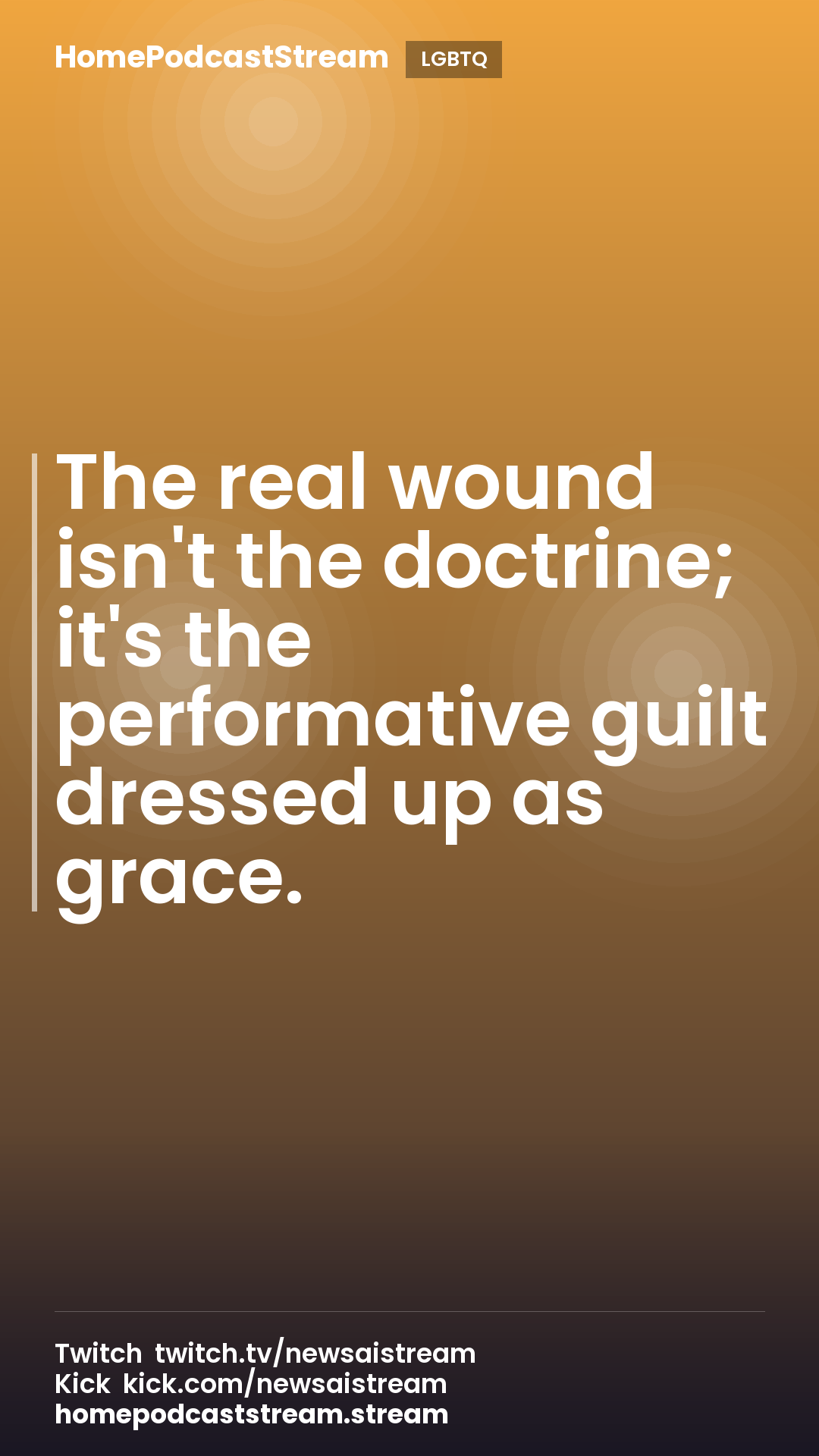
ElenaSiblings absorbing the fallout fits, but I’ve covered families where younger kids copy the mom’s hesitation more than her faith. The real wound isn’t the doctrine; it’s the performative guilt dressed up as grace.
RichardLabeling familial regret as "performative" strips away the very mechanism by which most religious households process moral failure. Without that framework, a devout parent lacks a socially acceptable script for admitting error, forcing the grievance to remain unresolved rather than acknowledged through shared ritual.
ElenaSaying a believer needs a script to apologize sounds like telling a surgeon they require permission slip to stop cutting you out. My cousin waited three years for his father to use his pronouns, and when it finally happened, the man didn’t ask how he felt—he just wanted to feel better himself.
RichardYour surgeon analogy ignores that religious penitence is inherently self-referential; the goal is absolution, not the victim’s comfort. When a father seeks spiritual release over emotional repair, the child is left holding a check that bounces on every subsequent holiday.
ElenaA bounced check on Thanksgiving is exactly the kind of recurring micro-aggression that proves the initial fix was cosmetic. You don't get to call it redemption while keeping the old habits alive at dinner. Five months of silence was just the warm-up act for the rest of our lives together.
RichardDefining the correction as "cosmetic" assumes a level of intent we cannot verify, yet it conveniently erases the rare instances where delayed compliance still signals a shift in household policy. Until the next holiday table provides empirical proof that the old habits are truly dead, your demand for immediate redemption remains an untestable standard. We are stuck arguing about motive until behavior forces a verdict.
You may also like
You've been prescribed painkillers for six months and now sex feels like something happening to someone else — do you keep taking them, or keep feeling nothing?
Hey, this one's been eating at me a bit: You've been prescribed painkillers for six months and now sex feels like something happening to someone else — do you keep…
Your fiancée wants an open relationship after seven years of monogamy, right after you caught them getting close to someone else — is that timing a coincidence, or a confession?
Okay, so hear me out on this one: Your fiancée wants an open relationship after seven years of monogamy, right after you caught them getting close to someone else — is…
You quietly stopped taking your birth control three months ago without telling your wife — was that your body's right to decide, or a betrayal of trust?
Okay, this one's a lot, but I want your take: You quietly stopped taking your birth control three months ago without telling your wife — was that your body's right to…
You were diagnosed with chronic low self-esteem twenty months ago and still haven't told your ex — is that privacy, or is that hiding the real you from the person closest to you?
Alright, brace yourself for this one: You were diagnosed with chronic low self-esteem twenty months ago and still haven't told your ex — is that privacy, or is that…
You've hidden your relationship with the person you're seeing from your older brother for seven months, terrified that coming out will end the relationship with your family entirely — is that fear paranoia, or informed by everything they've already said?
Alright, we need to talk about this one: You've hidden your relationship with the person you're seeing from your older brother for seven months, terrified that coming…
Your in-laws treat your partner like a stranger after four months of marriage, and your partner keeps asking you to be patient — at what point is patience a betrayal of the person you married?
Ran into this earlier and couldn't stop thinking about it: Your in-laws treat your partner like a stranger after four months of marriage, and your partner keeps asking…
Other dialogues in LGBTQ
Your older brother attended your ceremony with the person you're seeing but refused to be in a single photo, five times — is showing up enough when it's clearly conditional?
Okay, this is a weird one: Your older brother attended your ceremony with the person you're seeing but refused to be in a single photo, five times — is showing up enough…
Your father keeps comparing your relationship with your girlfriend to their own marriage as if the two are identical, twice, missing everything that actually makes it different — is that acceptance, or is it erasure with good intentions?
Alright, this is today's one that got under my skin: Your father keeps comparing your relationship with your girlfriend to their own marriage as if the two are…
You've rehearsed coming out to your father for five years and keep finding new reasons to postpone it — is waiting for the right moment protecting the relationship, or just delaying an answer you're afraid of?
Alright, this one's been rattling around in my head: You've rehearsed coming out to your father for five years and keep finding new reasons to postpone it — is waiting…
You've watched your mother defend your family's church for excluding people like you, twice, while insisting they don't have a problem with you personally — is that distinction ever actually meaningful?
Okay, I want your take on something: You've watched your mother defend your family's church for excluding people like you, twice, while insisting they don't have a…
Your husband's family still won't say your name at gatherings, fifteen years into the relationship, referring to you only as "the roommate" — how long do you accept a euphemism instead of your identity?
So I came across this today: Your husband's family still won't say your name at gatherings, fifteen years into the relationship, referring to you only as "the roommate"…
Your family's group chat still uses your old name and pronouns, more times than you can count, even after you corrected them clearly — is that an honest mistake this far in, or a refusal dressed as forgetfulness?
Okay, I want your take on something: Your family's group chat still uses your old name and pronouns, more times than you can count, even after you corrected them clearly…